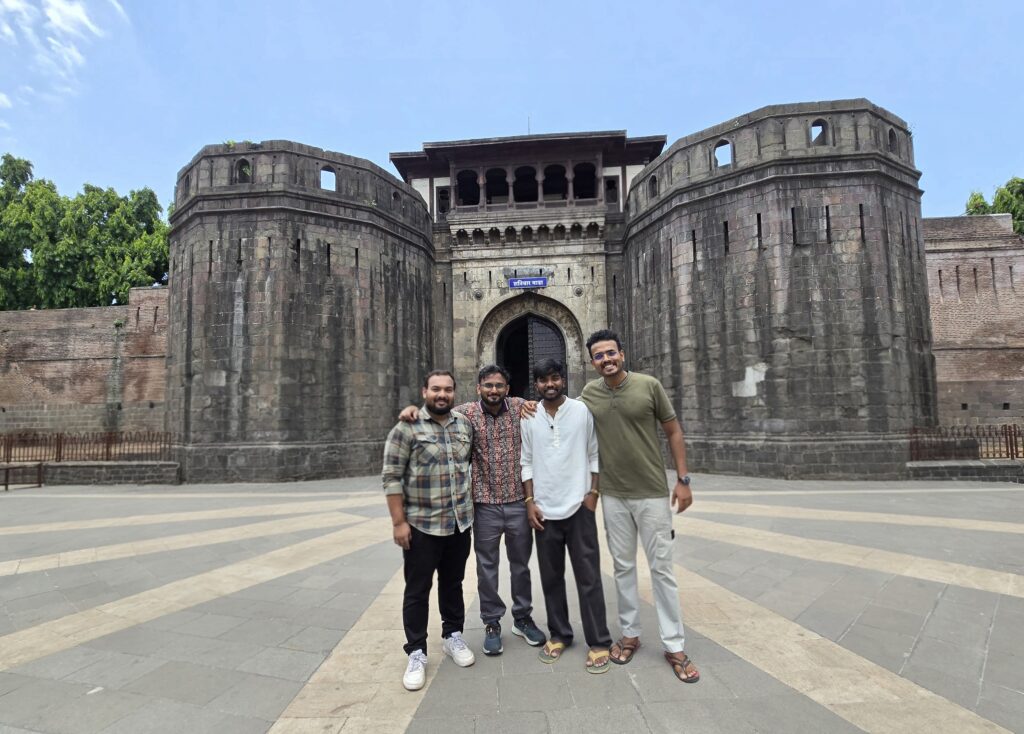
In the centre of Pune city, stands a fortified complex named Shaniwar Wada.
Just looking at this magnificent structure makes you travel back in time during the era of Marahta Empire when the structure was built by Peshwa Bajirao.
Shaniwar (Saturday) Wada (Residential Area/Compex) was built on 1732. The foundation stone was laid on a Saturday, therefore giving its name.
The moment you enter the complex after passing the magestic wooden doors, you see a beautiful open space with greenary all around. You are struck with open sky, huge trees and
a peice of history. Where once Bajirao Peswha lived, you are standing in that place. But one thing seems strange: why isn’t there any structure standing, but only open space? Did Peshwa Bajirao just build an open space? The answer is no.
As per historical documents, Shaniwar Wada was a seven-story building. The building was made of wood. During the time of Maratha empire, only Chhatrapati was allowed to build a stone building so the Peshwas had to build a structure from wood. A Peshwa was the second highest person in commmand during the Maratha Empire, next in rank to the Chhatrapati. It is said that during the peak of its time, Shaniwar Wada was resided by atleast one thousand people.
Teak wood was heavily used in the construction of the main structure. Foundation was laid on Saturday, 10th January 1730 and completed in 1732. The total cost of the construction at that time was Rs 16,110.
Shaniwar Wada has five gates:
-Delhi Darwaza (main gate)
-Khidki Darwaza
-Ganesh Darwaza
-Narayan Darwaza/Jambhul Darwaza
-Mastani Darwaza
Locals have said that after the fall of the Maratha Empire, the britishers burnt the wooden structure. The fire was so strong, it was burning for roughly around 7 days. What left was the stone foundation of the structure, which stand today as a testimony of the Maratha structure.
The complex had a Court Reception Hall, Dance Hall and a Mirror Hall. There’s also a lotus shaped fountain called the Hazari Karanje.
Shaniwar Wada is also the witness for the assasination of the young Peshwa Narayanrao. He was assasinated by his uncle Raghunathrao and aunt Anandibai. The last words of Narayanrao were “Kaka, mala vachva!” (Uncle, save me!). There’s some folklore that the locals still hear the ghost of Narayanro moving around in Shaniwar Wada.
After conquering Pune, the britishers took down the Maratha Flag and hoisted the flag of Union Jack. Peshwa Bajirao Rao II was exiled to to a place in Kanpur and the palace was seized. For sometime, the palace structure was converted to government office. Some portions were used as a mental asylum and prision as well. In 1828, as the fire burnt the structure, the britishers officially documented that it was an accident, locals heavily suspected foulplay. The britishers wanted to destroy the symbol of Maratha nationalism. Post-fire, the britishers took zero efforts to clear the debris. The site was neglected for decades and after a point, the ASI (Archaelogical Survey of India), cleaned up the place and started looking after it.
Today, Shaniwar Wada stands as a quiet reminder of a lost empire. The great fire destroyed the beautiful palace, leaving behind only the strongest parts that could survive: the heavy stone walls, the tough teakwood gates, and the deep foundations that still outline the ruins today.